среда, 25 апреля 2012 г.

Polo in Olimpic Games
Polo is a team sport played on horseback in which the objective is to score goals against an opposing team. Sometimes called, "The Sport of Kings", it was highly popularised by the British. Players score by driving a small white plastic or wooden ball into the opposing team's goal using a long-handled mallet. Polo is played professionally in 16 countries. It was formerly, but is not currently, an Olympic sport.The origins of Polo goes back to Persia.
If you want to know more,visit this link:http://en.wikipedia.org/wiki/Polo
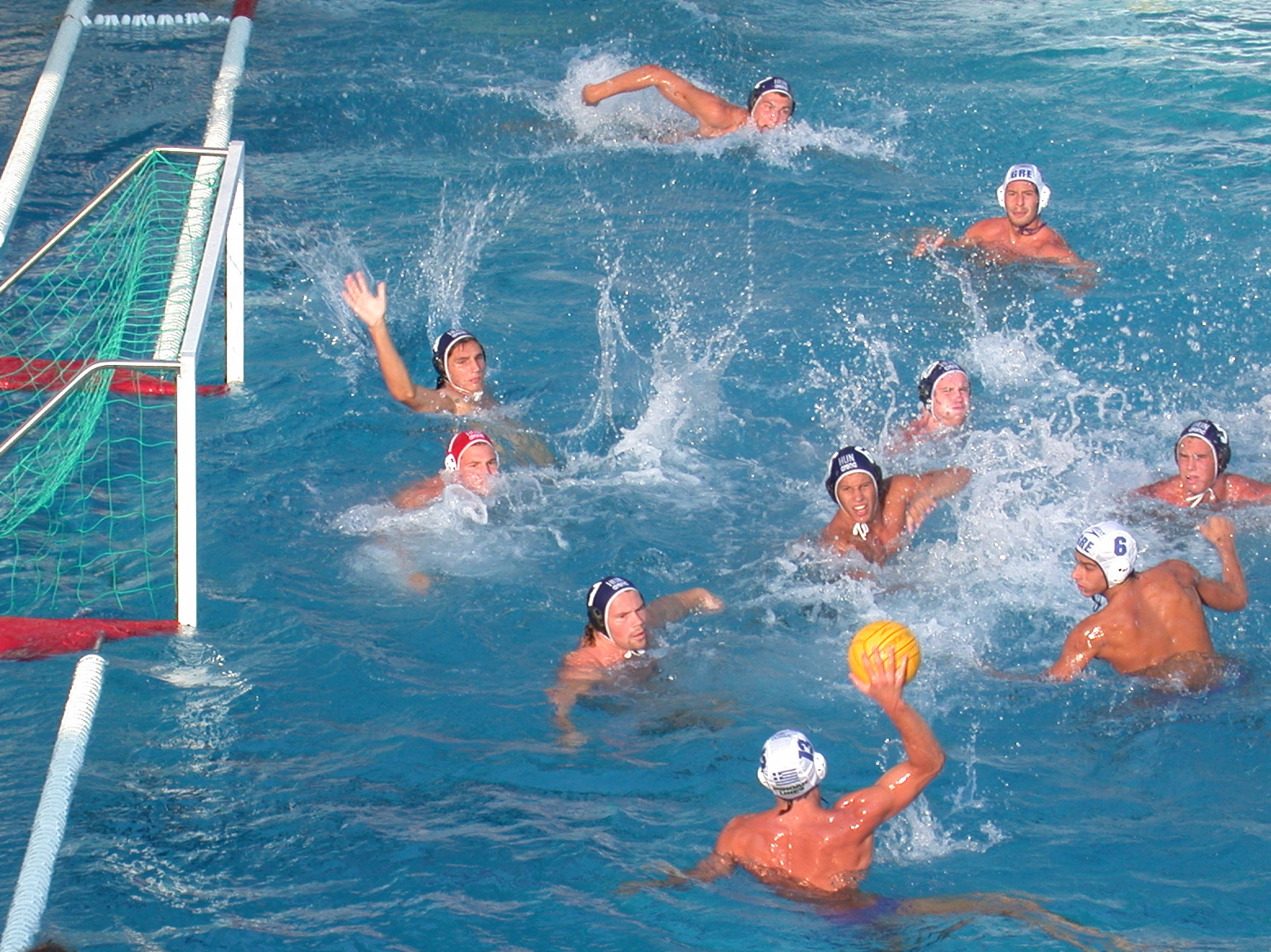
Water polo, or Water ball, is a team water sport. The playing team consists of six field players and one goalkeeper. The winner of the game is the team that scores the most goals. Game play involves swimming, treading water (using a sort of kicking motion known as "eggbeater kick"), players passing the ball while being defended by opponents, and scoring by throwing the ball into a net defended by a goalie. 'Man-up' (or 'power play') situations occur frequently. Water polo, therefore, has strong similarities to the land-based game of handball.
Additional information can be found here:http://en.wikipedia.org/wiki/Water_polo
Basic skills you need to have to play water polo:
- Swimming: Water polo is a team water sport requiring an ability to swim. Field players must swim end to end of a 30-meter pool non-stop many times during a game without touching the sides or bottom of the pool.
- Ball handling skills: As all field players are only allowed to touch the ball with one hand at a time, they must develop the ability to catch and throw the ball with either hand and also the ability to catch a ball from any direction, including across the body using the momentum of the incoming ball.
- Treading water: The most common form of water treading is generally referred to as "egg-beater",3 named because the circular movement of the legs resembles the motion of an egg-beater.
- Reflexes and Awareness: At higher levels of the sport the pace of play rapidly increases, so that anticipation and mental preparation is important.
Want to know more?Click on this link:http://www.mahalo.com/water-polo/
Here is an International Olympic Committee Water Polo Site:http://www.olympic.org/water-polo
среда, 18 января 2012 г.
J.Q.Adams 1825 - 1829
I have a task to learn about the 6th president of the United States, John Quincy Adams. Well, Wikipedia is unavailable today, so I've started from here:
http://www.answers.com/topic/john-quincy-adams
Besides a piece of general information I've found out some interesting facts.Actually he was a brilliant diplomat and very intelligent person, before he entered Harvard in 1785, he was proficient in Greek, Latin, French, Dutch, and German.
If you want to know his bio you should visit next links:
http://biography.yourdictionary.com/john-quincy-adams
http://www.cooperativeindividualism.org/miller_johnquincyadams.html
The last one consists of extracts from Arguing About Slavery by William Lee Miller.
 This is the photo of John Quincy Adams, taken from
http://www.answers.com/topic/john-quincy-adams
Besides a piece of general information I've found out some interesting facts.Actually he was a brilliant diplomat and very intelligent person, before he entered Harvard in 1785, he was proficient in Greek, Latin, French, Dutch, and German.
If you want to know his bio you should visit next links:
http://biography.yourdictionary.com/john-quincy-adams
http://www.cooperativeindividualism.org/miller_johnquincyadams.html
The last one consists of extracts from Arguing About Slavery by William Lee Miller.
This is the photo of John Quincy Adams, taken from среда, 16 ноября 2011 г.
Civil War was known as a man's fight. The image women had during the war wasas nurses, spies, or ladies maintaining the home in the absence of their husband. They even took arms and charged into battle, like the men. The women lived in camps, suffered in prisons, and died for their causes.
Using this link you'll be able to find more information about womens' activity during Civil War:
While searching some information on topic "Civil War in Rhode Island", I've found a copy of letter which was written by one participants. Here is the piece that impressed me the most:
"But, O Sarah! If the dead can come back to this earth and flit unseen around those they loved, I shall always be near you; in the brightest day and in the darkest night—amidst your happiest scenes and gloomiest hours—always, always; and if there be a soft breeze upon your cheek, it shall be my breath; or the cool air fans your throbbing temple, it shall be my spirit passing by."

This letter was written by Sullivan Ballou (March 28, 1829 – July 28, 1861). He was a lawyer, politician, and major in the United States Army. He is best remembered for the eloquent letter he wrote to his wife a week before he fought and was mortally wounded alongside his Rhode Island Volunteers in the First Battle of Bull Run.
Here you can find some more information:
http://en.wikipedia.org/wiki/Sullivan_Ballou
http://www.historynet.com/sullivan-ballou-the-macabre-fate-of-a-american-civil-war-major.htm
Using this link you will find a short information(also some photos are included):
http://www.findagrave.com/cgi-bin/fg.cgi?page=gr&GRid=1800

понедельник, 7 ноября 2011 г.
Karankawa people
Do you know the sense of word "Karankawa"? It's meaning is not certain. It is believed to mean "dog-lovers" or "dog-raisers." It were also a group of Native American peoples (also Karankawan, Clamcoëhs, and called in their language Auia) , now extinct as a tribal group, who played a pivotal part in early Texas history.
For more information about tribe visit these link:
http://en.wikipedia.org/wiki/Karankawa
 The Karankawa Indians lived along the Texas coast of the Gulf of Mexico. Their territory was from the west end of Galveston Island down the coast to where Corpus Christie is today. There were several bands, or maybe even several tribes. We are not sure, because much of the history of the Karankawa is lost. No one bothered to study them in any detail while they were still around to study. Making things worse, the Karankawa were favorite targets of many false myths and made up stories.
To find out the false myths enter the link:
http://www.texasindians.com/karank.htm
If you do not know were to spent your holiday, I can recommend you a nice place.Karankawa Plains is a hunting & nature tourism resort, located on the Texas Gulf Coast. Here you can enjoy birdwatching, wildlife viewing, canoeing, & horseback riding and also experience what it means to be а red man!
http://www.karankawa.com/
If you are really interested in Karankawa's history you should read this book.It was written in 1891 by Gatschet, Albert S.
http://texashistory.unt.edu/ark:/67531/metapth29754/

For more information about tribe visit these link:
http://en.wikipedia.org/wiki/Karankawa

To find out the false myths enter the link:
http://www.texasindians.com/karank.htm
If you do not know were to spent your holiday, I can recommend you a nice place.Karankawa Plains is a hunting & nature tourism resort, located on the Texas Gulf Coast. Here you can enjoy birdwatching, wildlife viewing, canoeing, & horseback riding and also experience what it means to be а red man!
http://www.karankawa.com/
If you are really interested in Karankawa's history you should read this book.It was written in 1891 by Gatschet, Albert S.
http://texashistory.unt.edu/ark:/67531/metapth29754/

picture from:
воскресенье, 30 октября 2011 г.
Population
Did you know that females made up approximately 52% of the population?
http://en.wikipedia.org/wiki/Rhode_island#Demographics
Here you can find the more information about population in Rhode Island.
http://quickfacts.census.gov/qfd/states/44000.html
This website includes table of comparison of the U.S. population and the population of separate state.It was really strange to find out that the average use of the other than English language at home in the Rhode Island is higher than average use of other language in the U.S.!!
http://www.kindredtrails.com/Rhode_Island_History-1.html
Information about native Americans and the explorers of Rhode Island.
http://en.wikipedia.org/wiki/File:Rhode_Island_population_map.png
Just click on the link and find out the geography of settlement the population!
Did you know that Spalding Rockwell Gray was born in Providence?!
http://www.thingstodo.com/states/RI/famous_people.htm
Visit this site and read more about famous people in Rhode Island!
Geography of Rhode Island
http://www.netstate.com/states/geography/ri_geography.htm
This website includes all general information about geography of the state.I like it! So if you are like me too lazy to read long articles, then this site is exactly what you need!

http://www.providenceri.com/richardbenjamin/RI_collection/thumbnail.html
Opening this site, you’ll be able to look at the photos made by Richard Benjamin and realize what it really means to be in Rhode Island! Here you can comprehend the beauty of this place.
http://www.usclimatedata.com/climate.php?location=USRI0005
Here you can find climate chart and information about average temperature and average annual precipitation.These would be useful for those who've decided to travel around the state.
History of Rhode Island
http://en.wikipedia.org/wiki/History_of_Rhode_Island
As you know Wikipedia is the most reliable resourse.That's why I've started from it. So here you can find all the general information about the history of Rhode Island.
http://www.visitrhodeisland.com/make-plans/facts-and-history/
Here you can find short information about foundation of the state. Also some facts about famous Rhode Islanders are available.
http://www.rilin.state.ri.us/RhodeIslandHistory/
This website includes a book about history of the state.So if you are bored this evening you can spend time with fun and benefits!
Did You Know?
Preferring the Articles of Confederation, Rhode Island refused to participate in creating the U.S. Constitution, and was the last of the original 13 states to ratify it. More information you can find in this site:
http://www.history.com/topics/rhode-island
http://www.e-referencedesk.com/resources/state-history-timeline/rhode-island.html
Here you can find a timeline of 17-20 century.


In September 1620, a merchant ship called the Mayflower set sail from Plymouth, a port on the southern coast of England. Typically, the Mayflower’s cargo was wine and dry goods, but on this trip the ship carried passengers: 102 of them, all hoping to start a new life on the other side of the Atlantic. Nearly 40 of these passengers were Protestant Separatists–they called themselves “Saints”–who hoped to establish a new church in the New World. Today, we often refer to the colonists who crossed the Atlantic on the Mayflower as “Pilgrims.”
http://en.wikipedia.org/wiki/Mayflower
http://www.history.com/topics/mayflower
It's also interesting to read about copy of Mayflower , which was built in Devon, England and crossed the Atlantic in 1957.
Here you can find more about full-scale reproduction of Mayflower
http://www.plimoth.org/what-see-do/mayflower-ii
The details of the ship, from the solid oak timbers and tarred hemp rigging to the wood and horn lanterns and hand-colored maps, have been carefully re-created to give you a sense of what the original 17th-century vessel was like!
четверг, 14 апреля 2011 г.
Sir Alfred Joseph Hitchcock - the best english filmmaker
Sir Alfred Joseph Hitchcock(13 August 1899 – 29 April 1980)was an English filmmaker and producer. After a successful career in his native United Kingdom in both silent films and early talkies, Hitchcock moved to Hollywood
Hitchcock directed more than fifty feature films in a career spanning six decades. Often regarded as the greatest British filmmaker, he came first in a 2007 poll of film critics in Britain's Daily Telegraph, which said: "Unquestionably the greatest filmmaker to emerge from these islands, Hitchcock did more than any director to shape modern cinema, which would be utterly different without him..."The magazine MovieMaker has hailed him as the most influential filmmaker of all-time,and he is widely regarded as one of cinema's most significant artists.
Hitchcock became famous for his expert and largely unrivaled control of pace and suspense, and his films draw heavily on both fear and fantasy. The films are known for their droll humour and witticisms, and these cinematic works often portray innocent people caught up in circumstances beyond their control or understanding. Many of Hitchcock's films have twist endings and thrilling plots featuring depictions of violence, murder, and crime.
Result of Hitchcock's life — 55 full-length films, many of which become classics of a world cinema. Besides, Alfred Hitchcock has directed also a series «Alfred Hitchcock represents 21 television movie» and two documentary films (both in 1944), 2 more film works remained incomplete. The most famous pictures are: “Dial M for Murder”, “Rebecca”, “Psycho”, “Rope”, “Rear Window”, “Vertigo”, etc.
There was the only one Hitchcock film to win the Academy Award for Best Picture – “Rebecca”(though the award did not go to Hitchcock but to producer David O. Selznick); four other films were nominated. In 1967, he was awarded the Irving G. Thalberg Memorial Award for lifetime achievement. He never won an Academy Award for direction of a film.
Hitchcock died on 29 April 1980, 9:17AM. He died peacefully in his sleep due to renal failure in Los Angeles , California Beverly Hills Pacific Ocean .
Source: http://en.wikipedia.org/wiki/Alfred_Hitchcock
The United Kingdom London 1889 in film) by William Friese Greene, a British inventor, who patented the process in 1890 (see 1890 in film). It is generally regarded that the British film industry enjoyed a 'golden age' in the 1940s, led by the studios of J. Arthur Rank and Alexander Korda.
A history of British cinema
The history of British cinema over the past forty years is one ups-and-downs, successes and failures. Here are just a few of them.
The 'swinging sixties'
The 1960s was a great decade for British films, there was a worlwide interest in British fashion, youth culture and the British. British directors started making films showing 'Swinging London' such as A Hard Day's Night starring with the Beatles, and Alfie starring Michail Caine as a working-class cockney. This attracted money from the United States Hollywood , England
The bad seventies
In the 1970s, everything changed. The Americans spent too much money on making films, had several box-office failures and went back to america
The mixed eighties
The 1980s saw the success of films like Chariots of Fire, and the great epic Ghandi. Howevere, the story of the British cinema in the 1980s was really about the relationship between the cinema and TV. TV channels started putting money into the film industry and even making films such as My Left Foot. Some people saw it as the beginning of a new relationship between the cinema and the TV industries - but others said that the arrival of TV meant the end of the cinema.
The successful nineties
In the 1990s, four Weddings and a funeral hit the big screen and was very successful around the world. This was followed by big hits like Sliding Doors and Notting Hills. Some people claimed that British cinema was back.
Nowadays
The big blockbuster films that are made in Britain UK
The British film industry and Hollywood
Many Hollywood films with a British dimension (based on British people, stories or events) have had enormous worldwide commercial success. Six of the top seven highest-grossing films worldwide of all time have some British historical, cultural or creative dimensions: Titanic, The Lord of the Rings, Pirates of the Caribbean and the Harry Potter movies. The second culturally American film on the list, Star Wars at number 9, was filmed principally in the UK
tale setting (Shrek), and about two-thirds of the top twenty most commercial films, with combined cinema revenues of about $13 billion, had a substantial British dimension.^
British influence can also be seen with the 'English Cycle' of Disney animated films, which include Alice in Wonderland, Peter Pan, The Jungle Book, Robin Hood, One Hundred and One Dalmatians, The Sword in the Stone, The Rescuers and The Many Adventures of Winnie the Pooh
The British film industry has a complex attitude to Hollywood U.S. Hollywood also provides work to British directors, actors, writers, production staff and studios, enables British history and stories to be made as films, and opens up the U.S. US
British actors and actresses have always been significant in international cinema. Well-known currently active performers include:
• Catherine Zeta-Jones Jude Law Julie Walters Bob Hoskins Kate Winslet Anthony Hopkins Christopher Lee Hugh Grant Daniel Radcliffe Daniel Craig Keira Knightley Orlando Bloom Ewan McGregor Patrick Stewart Robert Pattinson Rowan Atkinson
The British directors Alfred Hitchcock and David Lean are among the most critically acclaimed of all-time, with other important directors including Charlie Chaplin, Michael Powell Carol Reed and Ridley Scott. Many British actors have achieved international fame and critical success, including Julie Andrews, Richard Burton, Michael Caine, Charlie Chaplin, Sean Connery, Vivien Leigh, David Niven, Laurence Olivier, Peter Sellers and Kate Winslet Some of the most commercially successful films of all time have been produced in the United Kingdom, including the two highest-grossing film franchises (Harry Potter and James Bond). Ealing Studios has a claim to being the oldest continuously working film studio in the world.
Despite a history of important and successful productions, the industry has often been characterised by a debate about its identity and the level of American and European influence. Many British films are co-productions with American producers, often using both British and American actors, and British actors feature regularly in Hollywood films. Many successful Hollywood films have been based on British people, stories or events, including Titanic, The Lord of the Rings, Pirates of the Caribbean and the 'English Cycle' of Disney animated films.
In 2009 British films grossed around $2 billion worldwide and achieved a market share of around 7% globally and 17% in the United Kingdom UK British Academy
http://en.wikipedia.org/wiki/Cinema oftheUnitedKingdom
http://en.wikipedia.org/wiki/William FrieseGreene - the inventor of cinematography. www.starsand.us/photo/keira kniqhtley2.jpg
http://www.thenewhairstyles.com/wp-content/plugins/wp-o-matic/cache/665b2 ed-westwick-hair-st.vle-2011-2.ipg http://www.entertainmentwallpaper.com/images/desktops/celebritv/leighton meesterl3.jpg
http://biographymini.com/wp-content/uploads/2011/04/Daniel-Radcliffe-Profile.ipg
Подписаться на:
Сообщения (Atom)